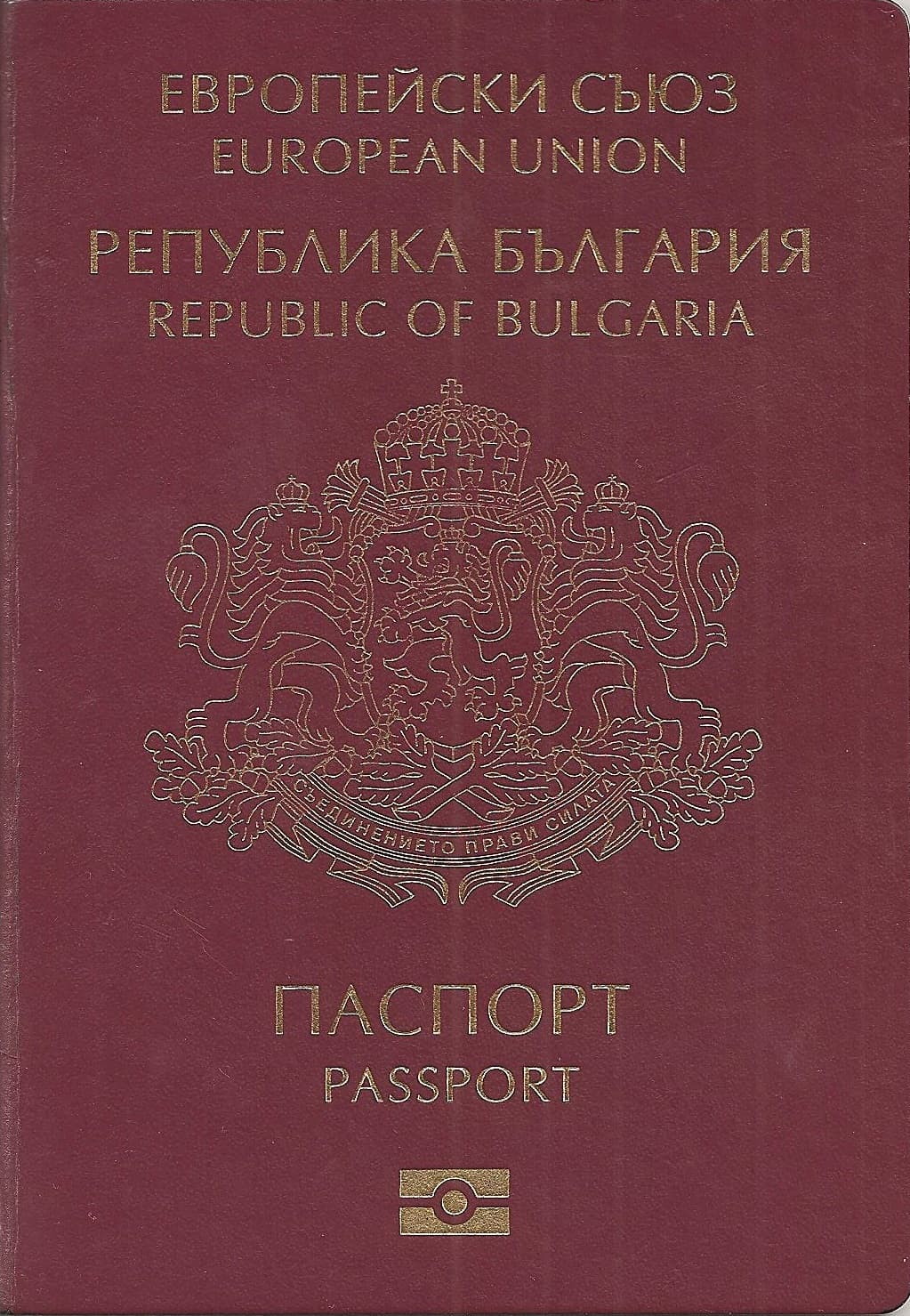
Who qualifies for Bulgarian citizenship by descent
Bulgarian citizenship law recognizes two main descent-based routes. The primary route covers descendants up to the third generation (great-grandparent) from a Bulgarian citizen, requiring documented lineage. Since a March 2021 amendment, Bulgarian origin is verified by the Ministry of Justice itself from official documents — civil records from Bulgarian or foreign authorities, or Bulgarian Orthodox Church records — rather than by a separate certificate from the State Agency for Bulgarians Abroad (DABA), which now only advises. No residency is required for either route. Dual citizenship is explicitly permitted.
Boarding pass · free tool
No sign-up · Private
Bulgaria eligibility checker
Answer a few questions about your Bulgaria ancestry. Takes under 2 minutes.
Country
Your answers are processed in your browser — we don’t store them or send them anywhere, including to analytics. The site itself uses analytics and, with your consent, ads. Privacy policy
Two routes with very different generational reach — pick based on your ancestor, not your preference
The standard descent route only reaches to the third degree — parent, grandparent, or great-grandparent. If your documented Bulgarian ancestor is a great-great-grandparent or further back, this route is closed to you regardless of how well you can document the lineage; there's no case to make for an exception.
Older guides describe a separate ethnic pathway with no generational limit. Since the February 2021 amendment that no longer exists: Bulgarian origin itself can only be proved to the third generation, and the evidence must come from official records. People with a Bulgarian great-great-grandparent or further back should build an origin case from official civil and church records rather than trying to force a standard-route case that the generational limit rules out.
The procedure has changed several times — check the current one
How Bulgarian origin is assessed has changed more than once since 2021, including which body examines it and whether a separate certificate of Bulgarian origin is needed first. Older guides, forum threads and law-firm pages often describe a procedure that no longer applies.
Before you start, check the Ministry of Justice's current instructions (or ask the Bulgarian consulate) for the forms, the evidence they accept, and whether any language assessment applies to you. What hasn't changed is the core test: Bulgarian origin, traced no further back than a great-grandparent, proved with official records.
Where the paper trail actually breaks
Bulgaria's civil registry has real gaps for records before 1945, especially in rural areas, and Ottoman-era administration before Bulgarian independence in 1878 means some family history sits in a completely different record-keeping tradition than modern civil registration. Church records, where the civil registry is thin, are commonly accepted as substitute evidence.
Communist-era name changes are the other recurring snag: many Bulgarian families had Christian, Turkish, or other non-Slavic names formally replaced with Bulgarian names under Communist-era policy, which means a birth certificate from that period may show a name your family no longer uses or recognizes. Reconciling the two names explicitly in your application, rather than assuming reviewers will infer it, avoids delays.
Proving Bulgarian origin
For the Article 15 route, Bulgarian origin must be proved from official documents: a birth, baptism or civil-status record of a parent, grandparent or great-grandparent showing Bulgarian origin, or a certificate of Bulgarian origin issued by the State Agency for Bulgarians Abroad. Since the February 2021 amendment, origin can be traced back only to the third generation. Applications go to the Ministry of Justice's Citizenship Directorate, directly or through a Bulgarian embassy.
Bulgarian citizenship by descent requirements
- A parent, grandparent or great-grandparent of Bulgarian origin, proved with official documents
- Documented lineage connecting the applicant to the Bulgarian ancestor across each generation
- Birth and marriage certificates for each generation in the chain
- Official records proving the ancestor's Bulgarian origin (civil-registry, citizenship or other state-issued documents)
- Application filed with the Bulgarian Ministry of Justice (directly or via a Bulgarian consulate); DABA no longer issues certificates of origin since March 2021
Documents for a Bulgarian claim
- 1Applicant's birth certificate and those of parents and grandparents (great-grandparents for third-generation claims)
- 2Marriage certificates for each couple in the lineage chain
- 3Proof of the ancestor's Bulgarian citizenship (Bulgarian birth certificate, old identity documents, civil registry extract)
- 4Official documents evidencing the ancestor's Bulgarian origin; church records may support but rarely suffice alone
- 5Apostilles on all foreign documents
- 6Certified Bulgarian translations of all non-Bulgarian documents
- 7Applicant's valid national passport
- 8Certificate of good standing / police clearance from the applicant's country of residence
Bulgarian processing times
Processing at the Ministry of Justice: commonly 12–24 months. Document gathering from Bulgarian national archives adds 2–6 months. Realistic total from start to Bulgarian passport: 18–30 months.
Where Bulgarian claims go wrong
- Generational limit: Bulgarian origin can only be proved to the third generation (great-grandparent) — a great-great-grandparent is too far back unless a closer relative acquires citizenship first
- Archive damage: Bulgaria's civil registry records from before 1945, particularly in rural areas, may be incomplete — church records and Ottoman-era archives are sometimes needed as substitutes
- Translation quality: the Bulgarian Ministry of Justice requires certified translations by an officially accredited translator; uncertified translations cause delays or rejections
- Evidence: Bulgarian origin must be proved with official documents — unsupported family accounts are rejected
- Communist-era name changes: many Bulgarian families had Christian or Western surnames replaced with Bulgarian names under Communist rule; birth certificates may use different names than family records
Official Bulgarian government sources
Bulgarian citizenship FAQ
Q1My Bulgarian ancestor is my great-great-grandparent — do I qualify under the standard route?
No. Since the February 2021 amendment, Bulgarian origin can only be proved to the third degree — great-grandparent. A more distant ancestor doesn't qualify on their own; if your parent or grandparent can claim within that limit and becomes Bulgarian first, your position changes.
Q2Do I need a separate Certificate of Bulgarian Origin before I can apply?
The procedure has changed several times since 2021, so check the Ministry of Justice's current instructions or ask the Bulgarian consulate. Guides that describe a fixed two-step certificate-then-application process may be out of date.
Q3What if my family's Bulgarian records use a different surname than we use today?
This is common — many Bulgarian families had names formally changed under Communist-era policy. Document both the historical and current names explicitly in your application (school records, church records, or other evidence linking them) rather than assuming the connection will be inferred.
Q4Do I have to give up my current citizenship to become Bulgarian?
No. People of Bulgarian origin who acquire Bulgarian citizenship are not required to renounce their existing nationality.
Q5How long does the Bulgarian-origin route take now?
Commonly 12–24 months at the Ministry of Justice, though gathering the underlying evidence of Bulgarian origin — especially from older or rural civil and church records — is usually what adds the most time before you can even submit.
Q6How far back can I trace Bulgarian origin?
Since February 2021, up to the third generation — a great-grandparent.
Bulgarian nationality law
Bulgarian citizenship is primarily governed by the Zakon za balgarskoto grazhdanstvo (Bulgarian Citizenship Act) of 1998, as amended. Article 8 establishes citizenship by descent for children of Bulgarian citizens. Article 15 lets people of Bulgarian origin naturalize without the usual residence requirement; since the February 2021 amendment, Bulgarian origin can only be traced to the third generation.
Dual citizenship in Bulgaria
Bulgaria explicitly permits dual and multiple citizenship. Bulgarian citizens who naturalize elsewhere do not lose their Bulgarian citizenship, and people of Bulgarian origin who acquire Bulgarian citizenship are not required to renounce their existing nationality. This is one of the more permissive EU states on dual citizenship.
Bulgarian application costs
Ministry of Justice application fee: BGN 80–200 (approx. €40–€100). Bulgarian civil registry extracts: €5–€15 per document. State Archive (DA) research: €10–€30 per session. Apostilles: €10–€40 per document. Certified Bulgarian translations: €40–€80 per document. Total for a 3-generation claim: approximately €400–€1,000.
Compare across countries: dual citizenship everywhere, citizenship through grandparents and through great-grandparents.